


Three months on, the longer shot has become the favourite. Much has changed since July:
- Affordability has become the defining issue of the campaign, with petrol above US$4 a gallon, diesel above US$6, 30-year mortgage rates at 7.4% and US CPI back up to 3.7% in September.
- The Fed hiked 25bps to 3.75–4.00% on 16 September, its first hike since 2023. In July we expected the Fed to hold under new Chair Warsh but energy-driven inflation forced its hand.
- The US 10-year yield broke through 5% for the first time since 2007, pulling long-end yields higher globally.
- Democrats have opened a near nine-point lead on the generic congressional ballot, and prediction markets now favour Democratic control of both chambers.
Our recent Trip Insights: The US (October 2026) covered company level detail and on the ground feedback from management meetings. Here we step back to look at the midterms: where the race stands, what each outcome means for US policy and bond yields, how it spills over globally, and what it means for global listed infrastructure (GLI). In short, the bond market matters more to our asset class than the ballot box.
Where the race stands
Midterms have historically been a referendum on the sitting President: the rare exceptions came when approval was above 60%. President Trump’s approval sits in the mid 30s, among the lowest of any President since 1945. Despite Trump’s State of the Union address, where he promised cheaper petrol and lower mortgage rates – he started the Iran War only four days later – delivering the opposite.
Chart – Trump’s approval (LHS) vs petrol prices (RHS)
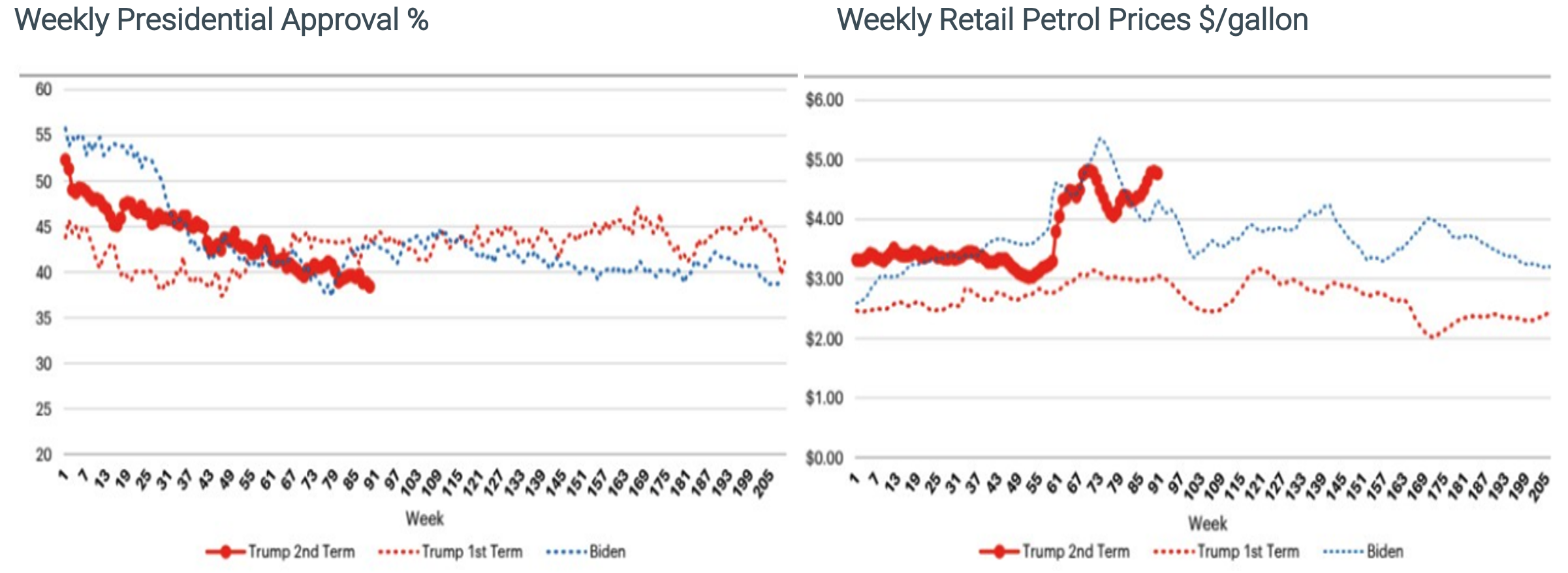 (Source – TD Cowen, Bloomberg)
Republicans hold the House 219–215, with one vacancy, and the Senate 53–47. Democrats therefore need a net gain of three House seats and four Senate seats; with Vice President Vance holding the tie-breaking vote, a 50–50 Senate would stay Republican.
Table – Senate & House seats; Current vs up for election in 2026
 1Includes special elections in Ohio and Florida.
2Includes two independents who caucus with the Democrats.
3 Includes one independent who caucuses with the Republicans; one further seat (TX-23, last held by a Republican) is vacant after Tony Gonzales resigned. A Senate majority requires 51 seats, as the Vice President breaks a 50–50 tie; a House majority requires 218. Senate figures as at 13 October 2026; House figures as at 19 October 2026.
(Source – 4D, Itau, Jefferies, Bloomberg)
Democrats lead the generic ballot by about nine points, the widest for any midterm since at least 2014. Polls have tended to understate Republicans, but even the largest October miss since 2006 (4.6 points) would still leave Democrats four points ahead.
Chart – Democrats generic ballot advantage continues to climb
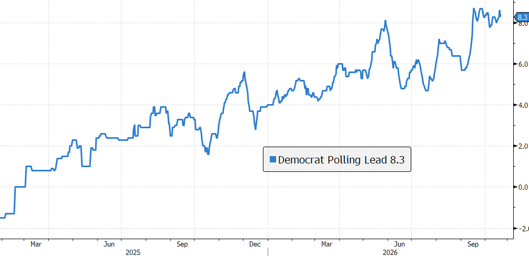 (Source – 4D, Bloomberg, Real Clear Politics Generic Congressional Vote polling data)
The Senate is the swing variable. Of the 35 seats on the ballot, Republicans are defending 22, but most are in safe, rural states, and Democrats likely need a national lead of at least six points to win the chamber. Democrats must flip four Republican-held seats. North Carolina is their best chance; beyond that, the path runs through Maine, Ohio, Texas, Alaska and Iowa – four of which Trump won by 11–14 points in 2024. Strong candidates have made this plausible: Democrats lead or are level in the polling average in all six, and Kansas and South Carolina have come into play. But outside North Carolina every lead is under five points, and a 2016- or 2024-sized polling miss would give Democrats the House but not the Senate. Democrats must also hold their own seats, including open seats in Michigan, where they lead by just two points, and Minnesota, where their lead is narrowing. Losing either would require a fifth pick-up in a deep-red state.
Chart – Democrats path to 51; North Carolina plus three toss-ups
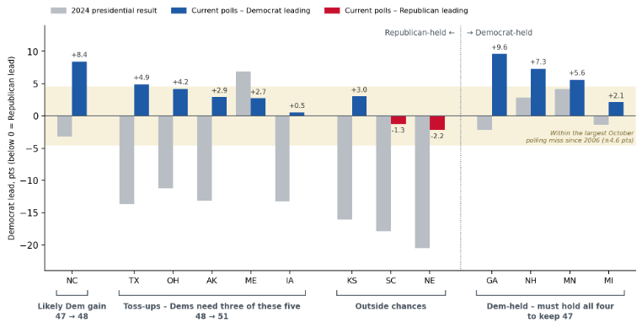 (Source – 4D, Itau, Jefferies, TD Cowen. 13 October 2026)
Despite still looking very uncertain, prediction markets put the odds of a Democratic sweep at 65% (21 October 2026)
Chart – Democratic sweep (prediction markets)
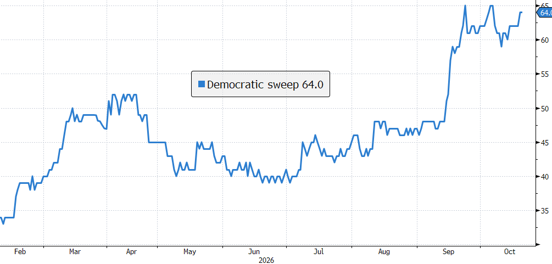 (Source – 4D, Bloomberg, Kalshi)
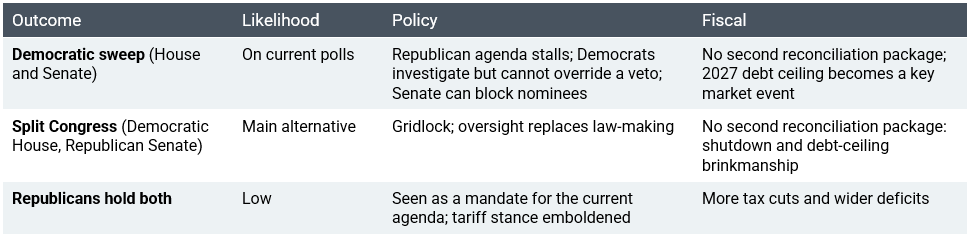
Below are our main takeaways on each potential outcome, and policy and fiscal implications.
What changes – and what doesn’t?
Whatever the result, the White House keeps the levers that matter most. The President retains the veto, and Democrats should be well short of the two thirds majority needed to override it, so tariffs, sanctions, energy and foreign policy remain largely with the executive. A Democratic Congress would govern by investigation rather than legislation – more noise, but few major policy changes.
The exception is the Senate’s power over appointments. Judges, Cabinet members and the commissioners of independent regulators all need Senate confirmation, and a Democratic Senate could block the President’s nominees. That matters for infrastructure: FERC (which approves gas pipelines and LNG terminals and oversees interstate power markets) and the NRC (nuclear) each have two commissioners whose terms expire during the next Congress. A Democratic Senate could force more moderate nominees, or leave seats vacant and slow approvals.
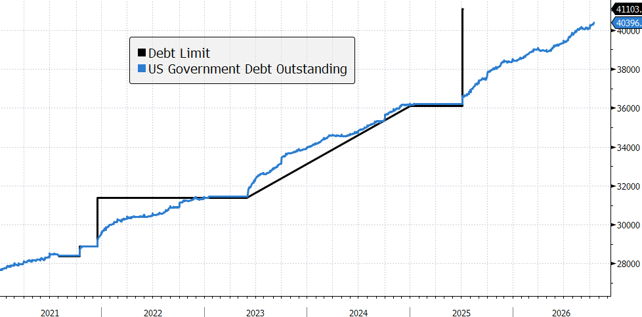
The bigger impact is on fiscal policy. Losing the House alone would end the prospect of a second reconciliation package (the fast-track process used for last year’s One Big Beautiful Bill Act) and turn the 2027 debt ceiling into the key market event, with the limit expected to bind early in the year and the Treasury running out of room around mid-2027. Unified Republican control would put more tax cuts and defence spending back on the table, and with them wider deficits.
Chart – US debt ceiling to be reached in Q1 2027 (USD $b)
 (Source – 4D, Bloomberg)
Two debates central to the infrastructure outlook remain live whatever the result;
- Permitting reform. Slow approvals are one of the biggest bottlenecks in the US energy investment cycle – new transmission lines, pipelines and grid connections take years to permit, and longer to clear legal chal-lenges. A bipartisan package that limits litigation under environmental law, curbs state vetoes of projects and expands the federal role in transmission faces its first Senate procedural vote when Congress returns on 9 November. The post-election ‘lame duck’ is the best window in years: much of the bill text already exists, sev-eral key negotiators are leaving, and must-pass bills such as the transport reauthorisation can carry it. Even so, the odds are modest (around 25%), with the administration’s intervention in wind and solar permitting the main sticking point. A deal would be a clear positive for electric utilities, midstream pipelines and US renewables developers; a Republican sweep would weaken the incentive to deal.
- Affordability. Residential power prices are around US$0.185/kWh, against roughly US$0.16 at the same point under President Biden and US$0.13 in Trump’s first term. Both parties are responding: Democrats have proposed making large users pay the full cost of grid connection, and a House Republican draft would shift da-ta centre grid costs away from households. But the decisions that matter sit with the states – 36 governor-ships are on the ballot, and in most states the governor appoints the regulators who set allowed returns. We expect pressure on allowed returns and a shift of costs onto large load customers rather than a halt to in-vestment, which is why we continue to favour states with lower relative bills and constructive regulators.
Yields – how high, and does the election matter?
The US 10 year yield held above 5% for the last month, up from below 4% in February, just before the Iran war. It closed at 5.31% on 5 October, its highest since 2007, and the 30-year has reached 5.60%, its highest since 2004.
Chart – Global ten year yields
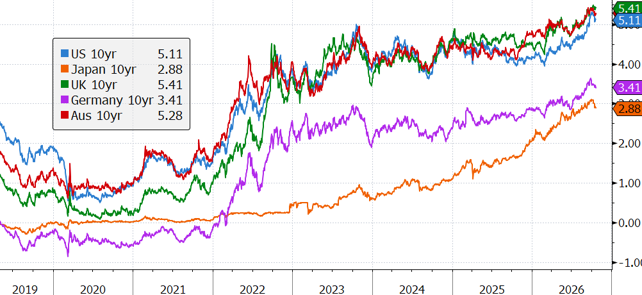 (Source- 4D, Bloomberg, 21 October 2026)
This move differs from 2025. Between September 2024 and the end of 2025, the Fed cut rates 175bps while 10-year yields rose 53bps – a rise driven by the ‘term premium’, the extra return investors demand for holding longer-dated bonds. In 2026, the move has been led by the Fed and inflation, with the whole curve shifting higher. Deficits, Treasury supply and AI-related borrowing still matter at the margin. Markets price an 87% chance of a further 25bps Fed hike at the 8–9 December meeting, and around three more hikes by mid-2027, with the implied policy rate peaking near 4.7%
In January we said Trump remained focused on long-term yields and that 5% was a key trigger point. The response has come through energy rather than a policy retreat – with a coordinated G7 release of crude and diesel, and a temporary licence for Russian diesel.
We see the election as a second order driver for bonds. At the margin, a Democratic Congress would be read as a check on deficits and a support for Fed independence, modestly positive for long bonds; unified Republican control would point the other way. We expect yields to stay elevated and volatile, with modest relief rather than a reversal under a Democratic sweep.
Why it matters beyond the US
For a global portfolio, the midterms matter most through their spillovers. We see four channels:
- Global discount rates. The US long end sets the tone for long bond yields globally, and Bunds, gilts and Australian bonds have their own fiscal and inflation pressures. Any relief on US term premium from a check on deficits would flow through to infrastructure valuations everywhere – but it would be relief, not a reversal.
- Energy. Once the vote passes, the White House’s incentive to hold down petrol prices weakens, while the Iran conflict remains unresolved and flows through Hormuz are still well below pre-war levels. As we noted in July, net energy importers in Europe and North Asia carry the most growth and inflation risk.
- Trade. Tariffs stay with the executive whatever the result, and we expect the effective US tariff rate to stay in the 10–20% range. A divided or Democratic Congress is seen as more constructive for the USMCA annual re-views, while restrictions on Chinese access to advanced chips have bipartisan support and could gain mo-mentum under a Democratic House.
- The US dollar. Views diverge on the currency impact. Some see a Democratic sweep as initially dollar-positive, by reducing fiscal and institutional risk premia; others see a weaker dollar as growth and rate differentials narrow. For emerging markets, we think the country specific dynamics will matter as much as any election driven move in the USD.
What does this mean for infrastructure & utilities?
As we outlined in July, the impact of higher rates and inflation varies across the asset class. User Pay assets (toll roads, airports, ports, rail) are geared to GDP growth and carry inflation protection in their tariffs, while within Regulated Utilities the return model matters more than the sector label – real rate utilities (Europe, Brazil) pass inflation and rates through to earnings, while nominal rate utilities (historically the US) are the true bond proxy.
Below is how we see the midterm outcomes playing out across the universe.
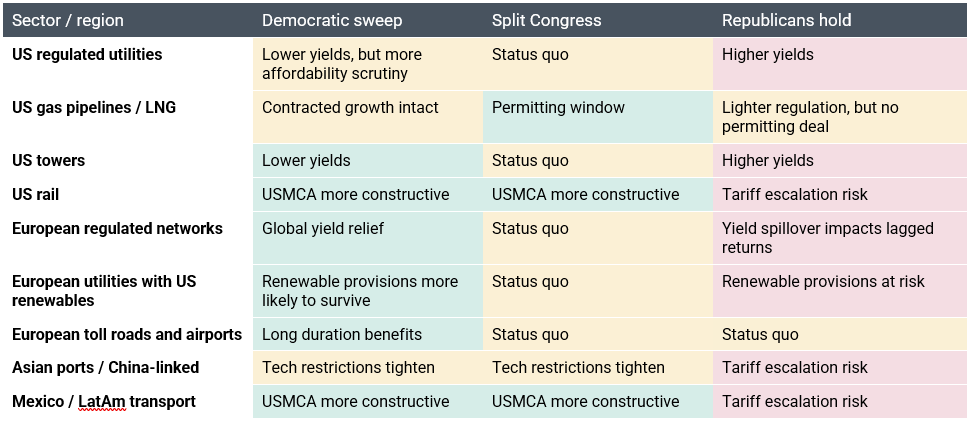 (Source – 4D. Green = relative positive; yellow = neutral; pink = relative negative)
North America
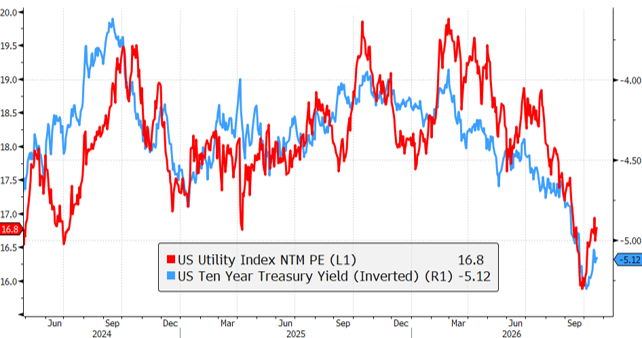
The AI-driven investment super-cycle that currently underpins US utility and midstream earnings does not depend on who controls Congress. The election shapes the political temperature around affordability, not the investment need. Higher long yields have weighed on US utility earnings and valuations this year (down from 20x PE to 17x as yields +100bps – see below chart). On an absolute P/E basis the sector is looking attractive.
Gas infrastructure is a beneficiary under any outcome, with largely contracted growth, while US towers remain the sector least insulated from higher yields.
Chart – US Utility PE v 10 yrs (inverted)
 (Source: 4D, Bloomberg)
Europe
The regulatory lag within real rate regulated networks is the clearest relative beneficiary of any fall in US term premium spilling into global yields, given their formulaic inflation and rate pass-through. Long duration concessions such as toll roads and airports could also benefit at the fringe. Against that, Europe remains the most exposed region to a renewed energy shock after the vote. A Democratic win would also strengthen the case for passing the US permitting bill with its renewable protections which matters for European utilities with large US businesses.
Asia
For Asia, the US election matters mainly through trade and tech. A Democratic House is likely to be more hawkish on China tech than today’s Congress, while tariff policy remains with the White House. Our China exposure is limited to names that can capitalise on exports and AI, and we remain cautious on those linked to domestic demand.
Latin America
A divided or Democratic Congress is seen as more constructive for USMCA than unified Republican control, which supports Mexican transport assets, including the Mexican airports we favour. In Brazil, inflation-linked infrastructure assets continue to compound regardless of the US political cycle – the local political cycle matters far more for the economy and risk sentiment.
What next?
4D see several events to monitor into 2027, not just the US midterms:
- Election night. New England (Maine and New Hampshire) is the early read on the Senate. A Republican surprise there would put the Senate back in play.
- The lame duck. The outgoing Congress keeps sitting, with the same members and majorities, from 9 November until the new Congress is sworn in on 3 January. Must-pass bills – government funding (the current stopgap expires on 11 December) and the transport reauthorisation – are the likeliest vehicles for permitting reform. If the Senate flips, Republicans have an incentive to use their final weeks to confirm nominees, but on-ly where there is a seat to fill: an existing vacancy, a term ending next year, or an official stepping down (possible Cabinet ‘musical chairs’). Judges matter most, as they serve for life. Regulators serve fixed terms, but since the Supreme Court’s Trump v. Slaughter ruling in June the President can remove them at will, so a Democratic Senate’s leverage lies in blocking replacements rather than protecting incumbents.
- The 2027 debt ceiling. Under a Democratic Congress, this becomes the main leverage point between Congress and the White House, and a source of front-end bond market volatility.
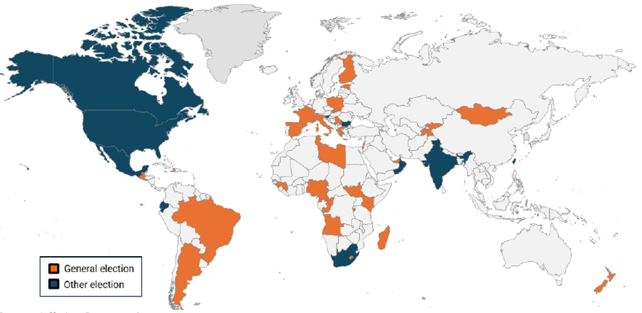
- A crowded electoral calendar. The next 12 months bring votes in Mexico, France, Spain and Poland. Elections rarely change the long-term need for energy, transport and digital infrastructure, but they can change the rules around it – regulated returns, concession terms, permitting and the timing of government project pipe-lines. They can also shift the macro outlook, growth, yields and fiscal deficits.
Chart – Upcoming country elections in 2026-27
 (Source: Jefferies)
Conclusions
The midterms look set to deliver what history predicts – a rebuke for the President’s party, driven this time by the cost of living. A Democratic sweep is now the base case. It would end any prospect of a second fiscal package and put the 2027 debt ceiling at the centre of markets, while leaving the White House in charge of tariffs, sanctions and foreign policy.
For global infrastructure, the election matters less than the bond market and the energy price. A Democratic Congress offers modest relief on term premium, but the Fed, energy and deficits will set the path for long-end yields – in the US and globally.
The fundamentals of our asset class are intact – the AI-driven US investment super-cycle, contracted gas infrastructure, and inflation-linked earnings in Europe and Latin America. As in July, we favour User Pay assets geared to GDP growth and inflation pass-through, and real rate utilities (in Europe & Brazil), while retaining select high quality US utility exposure. Politics will create volatility around the vote. As with past geopolitical flashpoints, we see that as an opportunity rather than a threat.
Download the full article below.
The content contained in this article represents the opinions of the authors. The authors may hold either long or short positions in securities of various companies discussed in the article. This commentary in no way constitutes a solicitation of business or investment advice. It is intended solely as an avenue for the authors to express their personal views on investing and for the entertainment of the reader.