


Key points
- Infrastructure frameworks are unchanged. As we wrote in our Trip Insights, neither candidate proposed reversing Brazil’s concession and regulatory frameworks or investment outlook. Our companies’ revenues remain contracted or regulated and explicitly inflation-linked. The need for investment remains significant and supported by political agenda’s.
- What has changed is the cost of capital. Markets priced a Flávio win and lower long term interest rates. Lula’s ultimate victory reversed that, pushing up interest rates and Brazil’s risk premium, which lowers the value on long life asset’s cashflows.
- The share-price fall looks overdone. Brazilian shares now trade below their level before the first round (when Lula was expected to win). The move in interest rates reflects immediate uncertainty on the fiscal policy outlook, that we think is overdone.
- We are being patient. We are not selling into the current re-positioning, but we are waiting for credible government appointments or concrete fiscal measures before adding; the appointment of market friendly Finance Minister should help reassure the market and move rates and share prices back to September levels at worst.
What happened
Lula won the 25 October runoff with 51.8% of valid votes to Flávio’s 48.2%, turning a first-round deficit of about 2.2 million votes into a winning margin of about 4.5 million. It was the first time since Brazil’s return to democracy that the first round leader lost the runoff.
Flávio initially threatened to challenge the result but has since stepped back, and the risk of a drawn out dispute has eased. Lula begins his fourth term on 5 January 2027 facing a Congress in which right-leaning parties have gained ground.
The surprise comeback came from a higher turnout and from voters who ultimately rejected the Bolsonaro family and/or supported national sovereignty. Abstention fell by the largest margin on record between rounds, bringing almost 3 million more people to the polls, especially in Lula’s Northeast stronghold. Most of the eliminated centre-right candidates endorsed Flávio, but their voters did not follow in sufficient numbers and some voters actually switched sides after President Trump praised Flávio's first-round result as a big victory and Lula reframed the runoff around national sovereignty and control of Brazil's natural resources. As we wrote before the vote, this was an election in which the winner would be the candidate fewer people rejected. Lula managed the perfect storm of voter shift between rounds.
How markets reacted
After the first round, Brazilian assets rallied strongly: the real moved below R$5 to the US dollar (from $5.20) and the Ibovespa, Brazil’s main share index, passed 200,000 points for the first time. That rally reversed in a single session after the runoff.
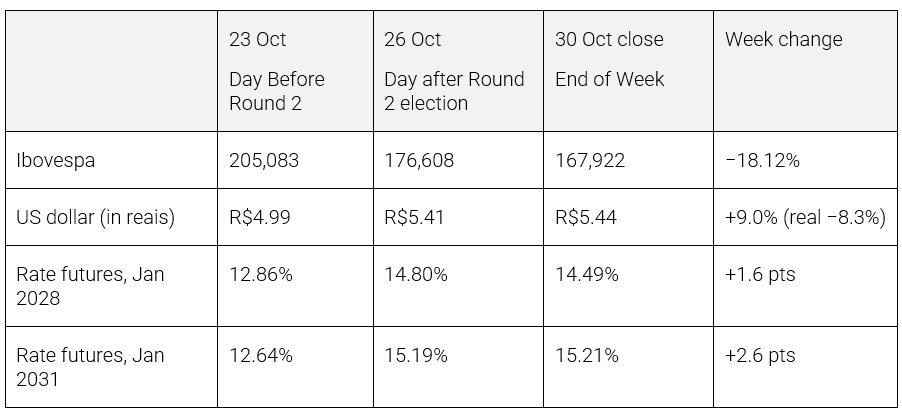 (Source: 4D Infrastructure, Bloomberg. Rate futures show where markets expect Brazilian interest rates to be on those dates)
Our Brazilian holdings were not spared, although most of their fall came on the first day. Much of the selling reflected investors unwinding positions built for a Flávio win rather than a reassessment of the underlying businesses.
Our fundamental positioning in Brazil ahead of Round 1 followed our recent trip to the region where we anticipated a Lula victory and some fiscal shifts into 2027. Like much of the market we had shifted expectations to a Flávio win after the first round - but we did take all market driven profits after October’s Round 1 rally before the run off. We believe the market is now over sold.
Why the market reacted: Brazil’s public finances
- Debt is high and spending is hard to cut. The key difference between the candidates was never infrastructure policy; it was the government’s finances. Brazil’s gross public debt is about 82% of GDP and rising, and around 90% of federal spending is mandatory, much of it pensions and welfare payments that rise with the minimum wage.
- Is the target enough. Lula’s government is targeting a primary budget surplus (the surplus before interest payments) of 1.5% of GDP by 2030. Most economists estimate that around 2–2.5% would be needed to stop debt rising at today’s interest rates.
- Rate cuts are on hold. With the central bank’s policy rate at 13.75%, markets no longer expect rate cuts and are now pricing some increases. The reverse is also true: credible measures to slow spending growth could bring interest rates down substantially, shifting market sentiment.
Reasons for optimism
- Election uncertainty is resolved and the outcome was the one widely expected before the first-round upset.
- The alternative carried its own risks. Flávio left Brazil on 27 October in defiance of a Supreme Court order to remain. As a first-time candidate with no executive record, his capacity to govern within institutional constraints was untested. For long-duration infrastructure, a continuity government working within known rules may prove the safer result.
- Appointments can move markets quickly. In 2002, Palocci at Finance and Meirelles at the central bank, followed by a higher primary surplus, drove a 12.5% Ibovespa rally by December that continued into 2003. Piauí governor Rafael Fonteles is now seen as the frontrunner, with Vice-President Geraldo Alckmin the alternative.
- Fiscal intent is already being signalled. On 27 October Finance Minister Dario Durigan proposed that budget freezes target the centre of the primary goal rather than its floor. The market has just shown what a credibility gap costs, so the incentive to close it is clear.
- The central bank anchor holds. Galípolo earned credibility by tightening aggressively. As Meirelles did in 2006, an independent central bank limits the downside. Copom held the Selic on Wednesday 4th November in a unanimous position supporting this independence and stressed how much fiscal policy weights on rate setting.
- Lula’s coalition points to the centre. Many right-leaning voters backed him to protect democratic institutions. That gives him the mandate and the incentive to govern from the centre, supporting fiscal credibility and the predictable environment infrastructure investors value.
- Congress is a fiscal check. A right-leaning Congress limits large spending increases, and a repeat of the 2022 transition amendment would be harder to pass.
- Valuations have reset. With real rates near 9%, quality infrastructure names have fallen sharply with no change to their cash flows. A weaker real, strong terms of trade and a record harvest support the wider economy.
What it means for our holdings
The businesses we own are operating as we saw on our trip, with explicit inflation hedges, limited exposure to GDP growth, within regulatory frameworks that are not in question and an infrastructure growth outlook that is exciting and politically supported. What has changed is the interest rate used to value them.
- Toll roads. Motiva remains our preferred way to own a recovery, with falling debt and contract amendments not yet reflected in its share price. Ecorodovias is the higher-beta option; its debt is close to its peak and higher rates raise refinancing costs, but we think the market has over penalised it.
- Water and sanitation. Sabesp and Copasa could lose some of the faster privatisation upside a Flávio win implied, but both are already privatised with contracted regulatory paths, so the growth case stands. For Sabesp in particular, a Tarciso victory in Sao Paulo could actually fast track growth as he looks to showcase infrastructure evolution ahead of the 2030 Presidential race.
- Electricity distribution. The sector’s fall looks excessive, particularly for privately controlled operators with indexed earnings and renewed concessions. Customer payment arrears are the main watchpoint but covered by regulatory construct.
- Transmission and hydro. These lower-risk names fell least. They remain defensive but now offer less relative value.
- State-linked names. The renewed risk of state-led policy weighs on companies with government shareholders, reinforcing our preference for privately controlled operators.
Our positioning
We are not selling into what we see as forced re-balance – with share prices’ well below pre-election levels when a Lula election was expected. Having taken some profits before the runoff, we are now below our pre-election positioning in Brazil. We will rebuild positions gradually as the government’s fiscal plans become concrete, focusing on high quality privately controlled operators, where share prices have fallen furthest relative to any change in fundamentals.
On the upside, Lula has reassured markets before: in 2002, credible economic appointments and a higher surplus target drove a strong rally in Brazilian assets. On the downside, a loosening of the fiscal rules or a currency fall that forces sharp Selic rate increases would weigh further on valuations.
Conclusion
Lula’s victory changed Brazil’s interest-rate outlook, not the frameworks that underpin our infrastructure investments. The sell-off has opened up value in high-quality businesses, but the path to a sustained recovery runs through credible fiscal measures. We remain committed to our Brazilian holdings and will add as those measures become clear.